
Introduction
Few individuals in the modern scientific world have redefined our understanding of nature as profoundly as Jane Goodall. With nothing more than a notebook, binoculars, and a passionate heart, she stepped into the forests of Tanzania in 1960 and changed the way humanity views the animal kingdom forever. Not only did her groundbreaking work on chimpanzees challenge deeply entrenched scientific norms, but her continued activism has also left a lasting impact on conservation, education, and environmental policy worldwide. In this article, we examine the life, work, and enduring legacy of Jane Goodall—a pioneering figure who bridged the gap between science and empathy.
Early Life: Seeds of a Naturalist
Jane Goodall was born on April 3, 1934, in London, England. As a child, her fascination with animals was evident. Her favourite toy was a stuffed chimpanzee named Jubilee, which she cherished for years. She spent hours observing birds, insects, and household pets, sometimes hiding in chicken coops for hours to watch hens lay eggs.
Despite lacking the financial means to attend university directly after high school, Jane Goodall’s dream of going to Africa never faded. She worked as a secretary and waitress to save money. In 1957, she finally travelled to Kenya, where her life would change forever after meeting famed anthropologist and palaeontologist Louis Leakey. Impressed by her curiosity and keen observational skills, Leakey offered her the chance of a lifetime: to study wild chimpanzees in what is now Gombe Stream National Park.
A Radical Approach to Science
In 1960, Jane Goodall arrived in Gombe, Tanzania, with her mother as her chaperone (a requirement at the time for a young single woman travelling alone in colonial Africa). With no formal scientific training, she approached her research with a fresh perspective—one unburdened by strict academic conventions. Unlike traditional primatologists who assigned subjects numbers, Goodall gave the chimpanzees names, such as David Greybeard, Flo, and Fifi, recognising them as unique individuals with distinct personalities and emotions.
This decision was controversial. Naming animals was seen as unscientific, too personal. But Goodall was convinced that animals, especially chimpanzees, were more like humans than previously acknowledged. Her groundbreaking discovery that chimpanzees made and used tools—specifically, modifying twigs to extract termites—challenged one of the core assumptions of biology: that only humans used tools.
Table: Jane Goodall’s Key Discoveries
| Discovery | Description | Impact on Science |
| Tool Making | Strong family ties, grieving behaviour, reconciliation | Challenged the belief that tool use was uniquely human |
| Meat Eating | Chimps hunted and consumed smaller animals | Disproved the theory that chimps were strictly herbivores |
| Emotional Bonds | Strong family ties, grieving behaviour, and reconciliation | Supported theories of emotional complexity in animals |
| Social Hierarchy | Dominance hierarchies, political alliances | Indicated a nuanced social system in non-human primates |
| Cultural Traditions | Different chimp groups used tools differently | Introduced the idea of animal cultures |
Academic Validation and Rising Fame
Despite lacking a college degree, Jane Goodall’s fieldwork soon gained recognition. Under Leakey’s guidance, she enrolled at Cambridge University in 1962, where she earned a PhD in Ethology—one of the few people ever admitted to a doctoral program without a bachelor’s degree. Her thesis, “Behaviour of the Free-Ranging Chimpanzee,” was based on her early research at Gombe.
Goodall’s methods, however, continued to spark debate. Critics argued that her tendency to describe chimpanzee behaviour with human-like emotions—such as joy, grief, or jealousy—was anthropomorphic and scientifically suspect. But over time, her findings were replicated, and her methods eventually accepted and respected.
She became not just a scientist but a public figure, aided by National Geographic documentaries, especially those filmed by her then-husband Hugo van Lawick, a Dutch wildlife photographer. These films brought Goodall’s work to a global audience and made her one of the most recognisable faces in wildlife research.
The Gombe Experience and Its Ethical Implications
The Gombe Stream Research Centre became one of the most detailed and long-running field studies in scientific history. Over the decades, researchers—many of them women inspired by Jane—continued to monitor chimpanzee life in meticulous detail. What they found was both inspiring and disturbing. On one hand, the chimps displayed compassion, playful joy, deep maternal care, and social grooming rituals that mirrored human interactions. On the other hand, they could be brutal: chimpanzee males patrolled borders, sometimes engaging in violent raids on rival groups, even killing intruders.
Females committed infanticide in some rare instances. These revelations painted a more complex picture of the natural world, one that reflected both the beauty and brutality of nature. Goodall often emphasised that these darker elements shouldn’t lead to judgment, but instead to understanding—reminding us that violence isn’t exclusive to humanity, nor is empathy. The ethical implications of her work were profound. If chimpanzees are sentient beings with emotional lives and social relationships, what responsibility do we have toward them? What rights do they have? These questions became central to Goodall’s later work in animal welfare and conservation.
Transition to Activism: From Scientist to Advocate
By the 1980s, Jane Goodall began to shift from observation to intervention. She realised that her beloved chimpanzees were under threat—not from predators, but from humans. Deforestation, poaching, disease transmission, and habitat fragmentation were decimating wild populations. According to the Jane Goodall Institute, chimpanzee populations have dropped from an estimated 1 million a century ago to fewer than 300,000 today.
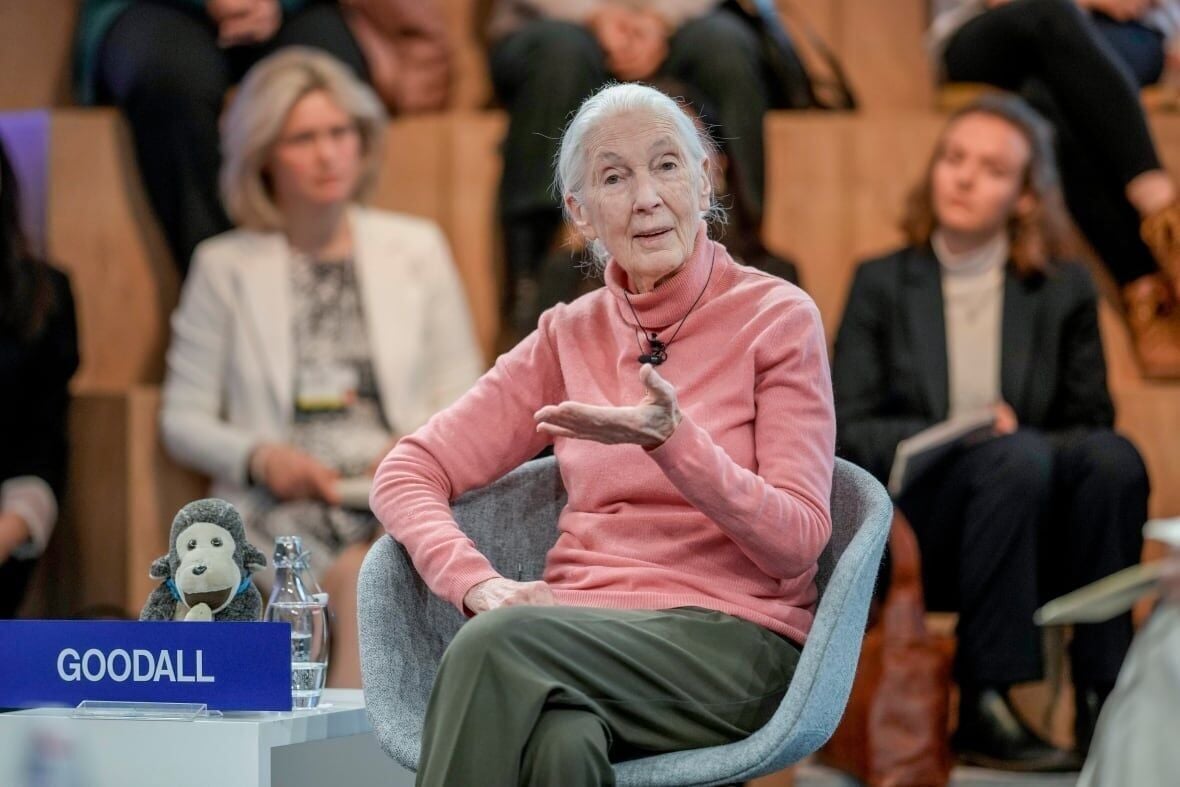
This realisation propelled her to leave the forest and take to the world stage. She began advocating for conservation, animal rights, and environmental protection, speaking at international conferences, universities, and even the United Nations.
In 1977, she founded the Jane Goodall Institute (JGI) to continue research, promote conservation, and support local communities living near wildlife habitats. She emphasised a holistic model—addressing human poverty and education alongside wildlife protection.
In 1991, she launched the Roots & Shoots program, a global youth initiative that empowers young people to create projects in environmentalism, animal welfare, and human rights. Today, Roots & Shoots operates in over 60 countries, involving hundreds of thousands of participants.
Ethical Conservation: A New Model
Jane Goodall’s approach to conservation was significantly different from that of many of her contemporaries. Instead of fortifying national parks with fences and guards, she advocated for community-based conservation. She believed that to protect wildlife, you must also support the people living near them.
Her model included:
- Providing education and healthcare to local communities
- Supporting women’s empowerment through microloans and vocational training
- Offering sustainable farming alternatives to reduce dependence on forest resources
- Collaborating with governments and NGOs to shape policy
This integrative approach not only conserved forests and chimpanzees but also improved human well-being. It was a win-win model that made her conservation efforts more sustainable and culturally sensitive.
Global Impact and Recognition
Over her lifetime, Jane Goodall has received more than 100 awards and honorary degrees, including:
- Dame Commander of the Order of the British Empire (DBE) in 2004
- The Kyoto Prize in 1990
- The Tyler Prize for Environmental Achievement in 1997
- The Templeton Prize in 2021
- Named UN Messenger of Peace in 2002 by Kofi Annan
She has published over 30 books, spanning scientific literature, children’s stories, and memoirs. Her voice is globally recognised, not only for its calmness and passion, but also for the depth of knowledge and moral clarity it brings.
Cultural Legacy and Media Presence
Jane Goodall has appeared in countless documentaries, interviews, and podcasts. Films such as “Jane” (2017), directed by Brett Morgen, have reignited public interest in her life and work. Her TED Talks, books like “In the Shadow of Man” and “Reason for Hope”, and children’s literature have reached audiences far beyond academia.
She’s been portrayed in popular culture, praised by celebrities, and admired by youth activists like Greta Thunberg. Her calm demeanour, signature ponytail, and soft-spoken but forceful voice have become icons of quiet strength and moral leadership.
Continuing the Mission
Even into her 90s, Jane Goodall continues to travel the world, speaking to audiences about climate change, biodiversity loss, and the importance of hope. She spends over 300 days a year on the road, although recent years have seen her increasingly adopt virtual platforms due to the COVID-19 pandemic.
Her message today is clear: “Every individual matters. Every individual has a role to play. Every individual makes a difference.”
She urges people to make daily choices—about food, energy, consumption—that reflect compassion and sustainability. Her campaigns for ending animal testing, improving farm animal welfare, and preserving forests have a global resonance.
Lessons from Jane Goodall’s Life
Perhaps the most powerful lesson from Jane Goodall’s life is the importance of observation and empathy. At a time when science prized detachment, she listened to her instincts and allowed herself to care deeply for her subjects. That emotional connection didn’t weaken her science—it strengthened it, leading to insights that a purely objective observer might not have seen. She proved that women belong in science, that youth can change the world, and that understanding nature requires more than data—it requires heart.
Her evolution from a young girl with a dream to a researcher in the African bush to a global icon of peace and environmentalism demonstrates how one life, rooted in passion and curiosity, can ripple out to change the world. She is not just a scientist; she is a bridge between species, a moral voice in a chaotic time, and a living example of what it means to live a purpose-driven life.
Conclusion: A Legacy of Hope
Jane Goodall is more than a scientist, more than an environmentalist—she is a global symbol of what is possible when one person follows a dream with unrelenting commitment. Her life’s work has expanded the boundaries of science, transformed conservation practices, and touched the lives of millions across cultures and generations.
Today, as the world faces unprecedented environmental challenges—from mass extinctions to climate collapse—her message remains as vital as ever. We are not separate from nature; we are a part of it. And it is our responsibility, as caretakers of this Earth, to act with urgency, wisdom, and hope.